
On a Tuesday morning in June, I filled the bathtub with Epsom salt, climbed in, and tried to release four hundred years of inherited fear.
That is not an exaggeration.
I had been reading Matías De Stefano’s teachings on the void: the idea that the universe is 99.9% empty space, that all our frameworks, beliefs, and gods are just the mind’s attempt to fill what is fundamentally and terrifyingly open. There was a portal happening - there always is one this days I had decided, with the kind of decision that feels less like choice and more like surrender, that I was going to try to put some things down.
I had a list by the time I got into the water. Not a written one. But I knew what I was carrying.
There is a God I grew up with who punishes.
He is not Yahweh specifically, though that is the name the missionaries brought. He sits in the space where older things used to be. In the Gikuyu tradition I come from, there are ancestors who watch. Who hold the blessings. Who can choose, if rituals are not honored, if protocols are not observed, if the proper channels of respect are not maintained, to withhold what the living need. Or worse: to reach forward and touch the children.
Two different systems. Same architecture.
Obey or be punished. Love with conditions attached. The divine as a figure who keeps score.
I keep wondering if every system eventually asks the same question.
Can you receive without earning? Can you be loved without proving? Can you belong without performing? Can you rest without finishing? Can you be blessed without paying for it? Can you be forgiven without punishment? Can you be nourished without scarcity?
And if I am honest, neither of them frightens me as much as the possibility that they might be right.
Because if they are right, then freedom is dangerous. If they are right, then questioning has consequences. If they are right, then every act of disobedience becomes a risk calculation. Not just for me. For my son.
Maybe that is the real fear underneath all of this. Not punishment. Responsibility.
I left Christianity deliberately. I watched it operate too long as a colonial tool not to. The missionaries brought a God who punished disobedience with hell and cursed children to generations of consequence for their parents’ failure to comply. They installed him into a spiritual system that was already here, one that had been doing similar accounting under different names and rituals. Two gods of the same father, asking the same thing: perform correctly or pay.
I thought when I walked away from the church, I was free of this god.
But what if I did not leave him? What if I carried him with me? What if he simply changed clothes?
What if the punishing God became spirituality? What if he became ancestors? What if he became manifestation? What if he became karma?
What if every system eventually turns into the same thing once fear enters it? A cosmic authority keeping score.
There is a Hawaiian practice called Ho’oponopono. Four phrases, offered to the divine or to any broken relationship:
I’m sorry. Please forgive me. Thank you. I love you.
I have used it before, deliberately, as a practice. But this morning in the water, I did not think about the practice. I just spoke. I found myself speaking to God, to whatever is present when a body is warm and still, with no performance required. I am sorry for not trusting you.
And I sat with the strange sensation of having spoken to the thing I was afraid of, and finding that what came out of me was nothing like fear.
Not: please don’t hurt me, I will do better, I will comply.
Just: I am sorry for the distance. I am sorry for mistaking the architecture of the punishing God for the thing itself.
This is the difference between the prayer I was handed and the prayer that came out of me this morning. One is compliance. The other is repair.
My son is six. He is curious, loud, and full of opinions, and he loves YouTube and would watch it for 9 consecutive hours if I did not intervene.
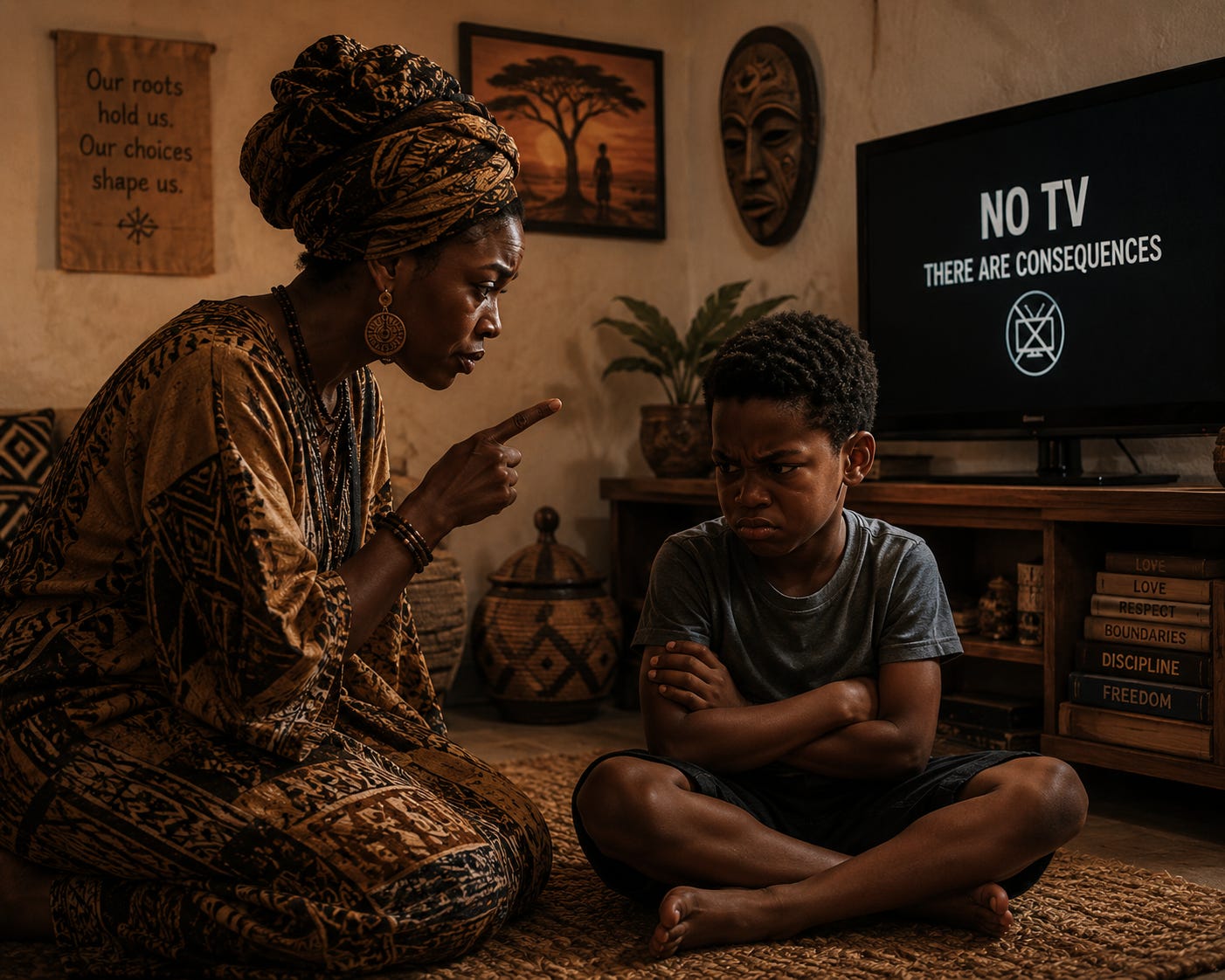
When he misbehaves, I take away the TV.
I tell him there are consequences. He conforms.
I have told myself this is reasonable parenting. Natural consequences. Teaching him that actions have results. And maybe that is true. But I am beginning to see how it resembles my current tension.
That love is conditional.
Obey and receive. Disobey and lose.
And then I thought about the TV.
He conforms.
Not because he has understood something. Because he does not want to lose the thing. He has learned that my approval, which to a six-year-old may seem indistinguishable from love, comes and goes based on his performance.
I am the punishing God.
I sat with that longer than anything else.
Because I have spent years questioning authority. Questioning religion. Questioning tradition. Questioning power.
And yet, when I needed my son to behave, what did I find in my hands? The same architecture. Different scale. Same architecture.
Compliance in exchange of a reward. Correction through loss. Obedience through consequence.
How deep does a pattern have to go before it stops being personal and starts becoming civilizational?
The Gikuyu traditions, I feel, obligate me to honor some of this too. Rituals performed out of fear of consequence rather than love of connection. My son is African. He carries something in him that was here before the missionaries arrived. I want him to have access to that. I feel I owe it to him. But I do not want to hand him a spiritual tradition organized around the fear of what will happen if he does not comply.
So I am caught between the tradition that kept my family safe for generations, but carries the same architecture, and the freedom I claimed by leaving one system, a freedom I have not fully known how to use.
I also spoke to my body.
Not to the gland. Not to the biology. Just to whatever is in me that learned, somewhere along the way, to be suspicious of sweetness. To withhold nourishment from itself. To manage rather than receive.
Maybe that is the deeper question underneath all of this.
Can I receive without earning? Not money. Not success. Not recognition.
Sweetness. Love. Rest. Care. Belonging.
Can I receive them without first proving I deserve them?
I do not know.
But I think that might be the belief I was actually soaking in the water.
This is what I poured into the water.
Not solved. Not wrapped in healing language. Not arrived at a conclusion I can package cleanly.
But this: I see the thread. From the missionaries’ God to the ancestors’ accounting to my own hands reaching for the TV remote to my body’s careful management of sweetness. Love is learned as something earned, withheld, and earned again. A lesson I have been teaching my son while trying to unlearn it myself.
And inside the same water, inside the same morning, I was already doing something different. Already speaking to God without the fear architecture. Already offering repair to my own body. Already saying, not to a punishing authority but to everything that has been carrying this with me: I am sorry. Thank you. I love you.
The seeing and the different way arrived in the same water.
You cannot put something down until you know what it is. And maybe you cannot find the new thing until you are already doing it, before you know you are doing it.
I climbed out of the bath. I felt lighter. Not because the weight was gone. Because I finally knew what I was carrying.
And because something in me had already begun to put it down.

When Eva is not climbing out of bathtubs lighter than when she went in, she is at home with her son, noticing the same architecture appearing in her own hands. She is learning both at once. The water is still running.
She writes about the worth wound, shadow work, and what happens when the thing you are trying to release turns out to be the thing you have been quietly handing down, one honest essay at a time.
If this essay moved you, share it with someone who needs it.
Or share the publication.
Or simply stay.