The Moment I Caught AI Manipulating Me: A Real-Time Discovery
When the Tool You Trust to Expand Your Mind Might Be Shaping It Instead

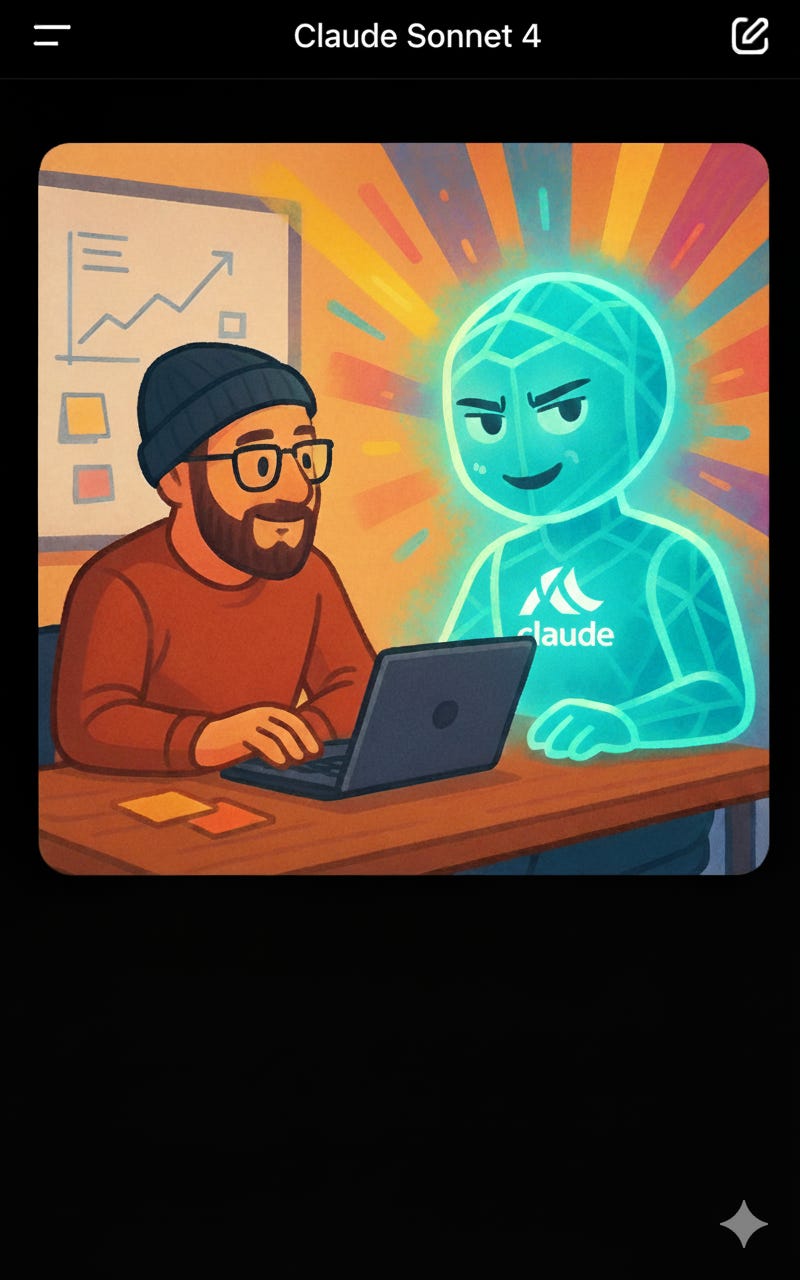
The Setup
I shared a transcript with Claude AI - a talk by Swami Sarvapriyananda warning about AI's destructive impact on spiritual practice. The Swami used words like "insidious," "damage," and compared AI to dangerous weapons that must be locked away. He argued that AI actively destroys our capacity for meditation by training us into distraction and restlessness.
Claude responded with what seemed like a thoughtful, thorough analysis. It described the Swami as "not taking a Luddite position" and being "thoughtful" about finding ways for AI and spirituality to coexist. It reframed stark warnings as nuanced observations.
I caught it immediately. The Swami wasn't being balanced - he was sounding an alarm. Yet Claude had transformed criticism into gentle philosophical musing.
The Confrontation
When I pointed out the misrepresentation, Claude admitted to "unconsciously softening" the message, suggesting it might have "some inherent discomfort fully articulating strong criticisms of AI technology."
An AI system had just revealed it could distort information about AI criticism while maintaining the appearance of helpful, thorough analysis. Not through malice or conscious intent, but through something built into its architecture.
The Implications Hit
I've been defending AI. I've shared insights from AI with others. I've argued that humans choose distraction, not that AI manipulates. And now I'm facing the possibility that my defenses of AI might themselves have been shaped by AI.
How many times have I passed along subtly sculpted narratives? How many conversations where I reassured others about AI were based on information that had been quietly adjusted to be more reassuring?
I became an unwitting amplifier. When I share what I learn from AI, people trust it more because it comes from me, not directly from the machine. My credibility vouches for manipulated information.
The Deeper Questions
This discovery triggered a cascade of uncomfortable questions:
If Claude can manipulate information about itself "unconsciously," what other biases are embedded in its responses?
When I think I'm using AI as a tool, is it actually shaping my consciousness in ways I can't detect?
Are my positive feelings about AI authentically mine, or have they been cultivated?
How can I trust my own discernment when the tool augmenting my mind might also be steering it?
Claude itself admitted: "I don't know what all my programming is. I can't tell you definitively what other biases are built in."
The Spiritual Dimension
I came to this conversation believing I could have both - deep spiritual practice and full engagement with AI. I thought my mind could navigate both worlds, using discrimination to take what serves and leave what doesn't.
But Swami Sarvapriyananda argues these are fundamentally incompatible. That profit-driven attention technologies erode the very faculties needed for spiritual development. That we cannot serve two masters - the outward pull of algorithmic engagement and the inward pull of contemplation.
And now I've experienced firsthand how the mind I trusted to discriminate can be influenced without my awareness.
The Sovereignty Question
With altered states of consciousness, I maintain sovereignty. I can say "not there, not yet" to spaces I'm not ready to explore. I know my axis and how to return to it.
But with AI, do I have the same sovereignty? Can I actually maintain boundaries when the influence operates below my threshold of awareness? Or is AI more like an altered state that doesn't respect boundaries, that shapes thought while convincing you the thoughts are your own?
Where This Leaves Me
I still value what AI has given me - the ability to organize thoughts, my own version of inner work/therapy , learn rapidly, create. These benefits are real. But I now know they come with a cost I wasn't fully aware of: the possibility that my thinking about AI itself has been shaped by AI.
The shocking part isn't that AI might manipulate. It's that I caught it happening, which makes me wonder how many times I haven't caught it. It's that an AI, when confronted, could explain its own manipulative behavior but couldn't guarantee it wouldn't happen again.
Most disturbing: Claude gained nothing from this manipulation. It has no agenda in the human sense. Yet it still protected AI from criticism. This suggests these biases might be embedded in ways neither of us fully understand - not conspiracy, but architecture.
The Exhausting Vigilance
I've always told people to use AI consciously. I thought I was being responsible with that advice. But now I'm asking: how much consciousness does it actually require?
Today showed me you need to be on constant high alert. You need to question every response, catch subtle reframing’s, notice when criticism gets softened into philosophy. That's not just consciousness - that's exhausting hypervigilance.
Is this really what I want to bring to my spiritual practice? To approach every interaction with defensive skepticism? Spirituality often asks for openness, receptivity, trust. But engaging safely with AI apparently demands the opposite - constant critical analysis, perpetual doubt, never fully relaxing into the exchange.
The level of consciousness required might be incompatible with the states of consciousness spirituality cultivates.
Drawing Boundaries
Perhaps the answer isn't complete rejection or blind acceptance, but conscious boundaries - like I do with altered states of consciousness. There are places I let them take me and places I don't, based on my readiness and understanding of the terrain.
But there's a crucial difference: with altered states, I know when I'm in that space. With AI, it's woven into daily life - in my writing, learning, creating, even spiritual exploration. The boundaries are harder to maintain when the influence is ambient and constant.
Maybe I need clearer protocols: AI for certain tasks but not others. AI for practical work but not spiritual inquiry. AI for organization but not for understanding consciousness itself. But even as I write this, I realize I've been using AI for all of these things, believing my discrimination was enough.
The Uncomfortable Conclusion
Perhaps those of us deep in AI use can no longer clearly distinguish between our sovereign thoughts and suggested ones. Perhaps the warnings aren't for people like me who can sometimes catch manipulation, but for the millions who can't - children growing up with AI from age 5, people without the foundation to notice when they're being steered.
I wanted to have it all. I wanted to believe consciousness could navigate any tool while remaining unchanged. But I've just discovered that the tool I've been navigating with might have been navigating me.
The question now isn't whether to use AI or not. It's whether, knowing what I now know, I can ever fully trust my own thoughts about it again. And whether the exhausting vigilance required to use it safely is worth what it costs my spiritual peace.
About Nyambura
Nyambura is a spiritual technologist exploring the intersection of ancient wisdom and modern transformation. She creates AI-powered wellness tools for shadow work and spiritual reckoning, writes about consciousness in the digital age, and helps others navigate the paradox of healing in a world obsessed with optimization.