

Kenya still breathes with the rhythm of creation. While many nations look back at their forests and animals as memories, we still walk among them. Our elephants still remember the ancient trails. Our lions still roar into the dawn. Our coral reefs still glow with living color. And on the coast, near the Indian Ocean, stands a sacred hill called Mrima — a place where the earth’s own heart still beats.
Mrima Hill is more than soil and stone. It is a living altar. Beneath its trees lie some of the rarest minerals on Earth — niobium and rare-earth elements, the same materials that make modern life move: from electric cars and satellites to phones and artificial intelligence. The world calls them critical minerals. We call them the bones of the Earth.
Scientists estimate that Mrima Hill holds over 60 billion US dollars in rare-earth deposits and about 35 billion dollars in niobium — value that could easily pass 100 billion when fully developed. Already, international eyes are fixed on it. Australian companies like RareX Ltd and Iluka Resources have formed a consortium to explore and mine this sacred hill, eager to feed the global supply chains that hunger for these elements. To many, this is an opportunity. To others, it is a warning.
The world is already watching — not only for the minerals beneath Mrima Hill but for the power they represent. In November 2025, U.S. Vice President J.D. Vance is scheduled to visit Kenya from November 24 to 27 — the first high-level American visit of its kind in fifteen years. The agenda: trade, technology, security — and Africa’s critical-mineral future. For Kenya, and for all of Africa, this means the decision about Mrima Hill is not just local — it is geopolitical. How we guard our ground will echo far beyond our borders.
For generations, the people of Kwale have gone to that hill to pray, to pour libations, to speak with the unseen. They never needed to read a geology report to know something powerful lived there. They could feel it. The hill breathes because it is alive with both the mineral memory of ancient volcanic activity and the prayers of countless generations. Indigenous cosmology teaches that certain places are thin spaces — where the veil between the physical and spiritual is permeable, where the Earth’s electromagnetic field pulses stronger, where water flows underground in sacred patterns. Modern geology confirms what ancestors already knew: Mrima Hill is a carbonatite complex, formed from the deep mantle of the Earth, pushed up through volcanic forces millions of years ago. It is, quite literally, the Earth’s deep breath made solid.
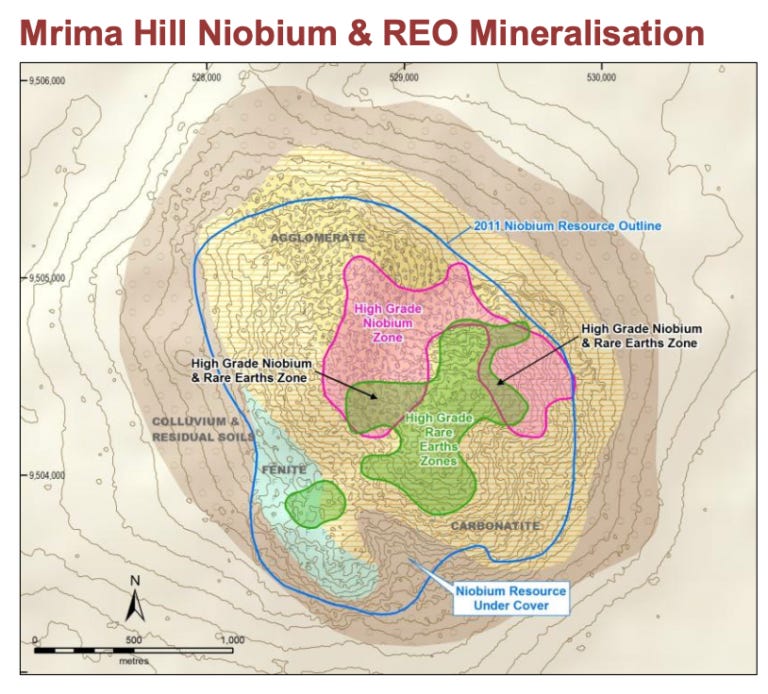
The people of Kwale understood that the ground itself listens, remembers, and responds. They understood that the hill breathes — and that when we extract without reverence, we risk stopping that breath forever.
I have travelled the world and seen what happens when a people forget this covenant between land and life. In some countries, the animals are only stories in books; in others, rivers no longer reach the sea. They did not mean harm; they simply took more than they tended. They called it progress. But progress without reverence becomes destruction wearing a suit.
Kenya must not follow that path. We are still the keepers of something rare — not only minerals, but memory. Our wildlife, our forests, and our sacred hills are not luxuries. They are Kenya’s identity documents. They prove that we still remember how to live with the world, not just on top of it.
The Bible itself tells of stones that carried meaning — jasper, onyx, sapphire, agate, emerald, amethyst. The high priest wore them on his breastplate as symbols of the tribes of Israel. Even in Revelation, the walls of the holy city were built from precious stones. These were not decorations. They were reminders that the divine lives in matter — that the Creator placed wisdom inside creation. Quartz can hold an electric charge; that is physics. But it can also hold memory; that is mystery. To touch a stone is to touch the language of God written in the earth.
So when foreign powers come to us with contracts and smiles, eager for our “rare earths,” we must ask: rare for whom? Rare because the world has mined its own spirit to exhaustion. Rare because the rest of the planet has already traded reverence for profit. But Africa still holds the heartbeat of the planet. If we sell blindly, we are not just losing wealth — we are losing the world’s last rhythm of balance. When Mrima Hill stops breathing, something in the global body dies with it.
I am not against development. I am for wise development.
Africa has already shown us the path forward — and it shines from Botswana.
When Botswana gained independence in 1966, it was one of the poorest nations on Earth. Then diamonds were discovered beneath the Kalahari. The world came rushing with open contracts and hungry promises. But Botswana did something radical: they said no to quick extraction and yes to sovereign control.
They formed Debswana — a 50-50 partnership between the government and De Beers, ensuring that half of all diamond wealth stayed in Botswana’s hands. More importantly, they built their own sorting, cutting, and polishing industries. They didn’t just export raw stones; they exported finished jewelry, capturing the full value chain. They invested diamond revenue into education, healthcare, and infrastructure. Today, Botswana has one of the highest GDP per capita rates in Africa, near-universal literacy, and a thriving middle class.
The lesson is clear: sovereign control, local processing, and long-term reinvestment transform minerals from curses into blessings.
Kenya must learn from this. Let us not merely sell niobium and rare earths to foreign corporations. Let us demand:
Majority Kenyan ownership in all mining ventures (51% minimum)
Local processing facilities that refine rare earths into finished products right here
Technology transfer agreements that train Kenyan engineers and scientists
Environmental bonds held in escrow to restore land after extraction
Sacred site protection clauses that keep certain areas of Mrima Hill untouched
Revenue allocation that directs mining profits into renewable energy, education, and ecosystem restoration
Let us mine knowledge before we mine the ground. Build research centers at our universities to study carbonatite geology, rare-earth processing, and sustainable extraction methods. Train a generation of Kenyan geologists, environmental scientists, and spiritual ecologists who understand both the microscope and the prayer drum.
Let us remember that development and reverence can coexist. Norway extracts oil while protecting its fjords. Costa Rica generates wealth from ecotourism while preserving 25% of its land. Bhutan measures Gross National Happiness alongside GDP. Kenya can mine its minerals while keeping its sacred hills breathing.
But this requires something the world often forgets: patience. The Australian consortium wants to move fast. The global supply chain is impatient. But the Hill has been breathing for millions of years. It can wait for us to get this right.
When people say, “We connect directly to God,” I agree. But God answers through His creation: through rain, rivers, trees, and soil. If we destroy what carries His answer, we are praying into silence. A forest is a form of prayer; it rises, it breathes, it blesses. A river is a verse; it carries the voice of the mountain to the sea. A hill like Mrima is a heartbeat — its minerals are the blood of the Earth, circulating through time. When we extract without ceremony, without gratitude, without limits, we are not mining; we are performing heart surgery with a bulldozer.
The people of Kwale know this. Before any stone is moved, libations must be poured. The ancestors must be consulted. The hill must be asked permission. This is not superstition; it is ecological wisdom translated into ritual. It is the recognition that extraction is a covenant, not a conquest.
So, my brothers and sisters across Africa: awaken. Do not let the hunger of the world eat what keeps you alive. Guard your hills, your waters, your forests. Respect the minerals beneath your feet, for they are the memory of God’s own chemistry.
To policymakers in Nairobi: Study Botswana. Reject any deal that does not put Kenyan sovereignty first. Build the processing plants. Train the scientists. Protect the sacred sites. Move slowly. Move wisely.
To activists and communities in Kwale: Your prayers are policy. Your presence is resistance. Document everything. Organize. Make your voices heard before the bulldozers arrive. The hill needs you to speak for it.
To international partners: Come with respect, not just contracts. Recognize that you are not entering a transaction but a relationship. If you cannot honor the land’s spirit, you have no right to its minerals.
To the global community watching this moment: Understand that what happens at Mrima Hill will set the precedent for Africa’s mineral future. If Kenya can mine with wisdom and reverence, it will prove that the old false choice — development or preservation — was always a lie. We can have both, if we are brave enough to move slowly and think sacredly.
Let Kenya be the example that development and reverence can live in the same sentence. Let Africa be the teacher again — the continent that reminds the world that the Earth is not a machine but a living prayer.
May we walk gently with creation. May we keep the rain falling, the forests breathing, the elephants roaming, and the hills singing. May we never trade the spirit of our land for the comfort of another’s coin.
For when the Hill that Breathes still stands, so does our future. And when its breath is honored, not just extracted, the whole world learns to breathe again.
About Nyambura
Nyambura is a Kenyan technologist and writer fusing ancestral wisdom with AI innovation. She builds emotional intelligence systems, authors eco-spiritual commentary, and advocates for sovereign control of Africa’s sacred resources. Her work explores the paradox of progress: How do we develop without destroying what makes us whole?
Connect:
🌐 inkandshadowtales.com | ✉️info@inkandshadowtales.com | 💼 LinkedIn