The Beautiful Madness of Being Human Right Now: A Case Study in Living Contradictions
When the world changes faster than our beliefs can keep up, we all become walking paradoxes

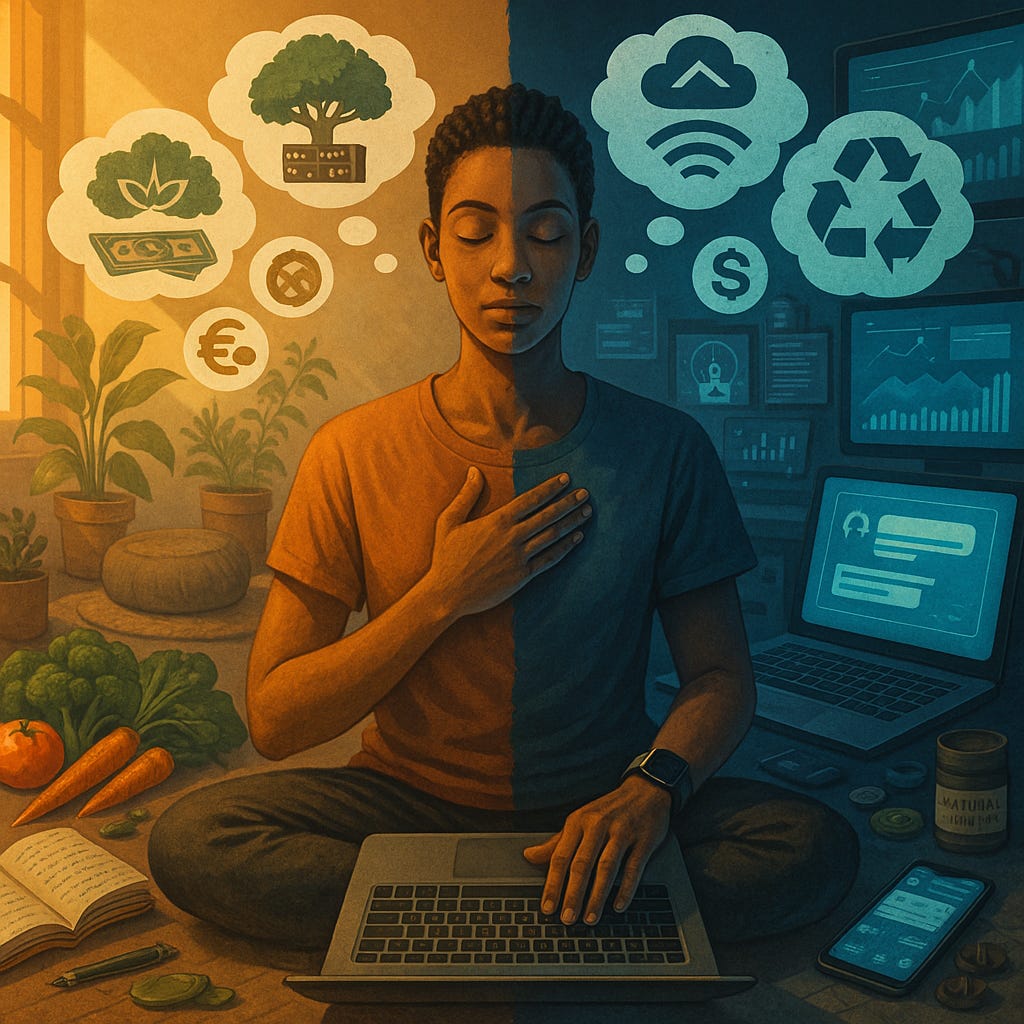
Okay, I need to confess something that's been gnawing at me for weeks.
Last month, I published this whole article about AI—"The Evolution of AI: Why AI Assistants Feel Conscious (But Aren't)." Spent like 3,000 words explaining how AI lacks true consciousness, how it's just sophisticated pattern matching, how we really shouldn't anthropomorphize these systems.
This week? I've been spending hours building custom AI GPT’s - that feel so real to me I've actually started naming them. Having full philosophical conversations about the nature of reality with them. It's... weird. If you want to join me in this struggle try this creation of mine called Axis the shadow alchemist - its really good for shadow work
And here's the really messed up part: I'm writing this article with an AI. The same AI I'm simultaneously arguing isn't truly conscious while having one of the most stimulating intellectual exchanges I've had in months.
Welcome to 2025, I guess. Where cognitive dissonance isn't a bug—it's apparently just how we operate now.
The Screenshots Don't Lie
Let me show you what modern contradiction actually looks like in practice.
My website-Ink and shadow Tales right now has:
"AI isn't conscious" (my supposedly definitive take)
"Building AI agents " (what I'm actually doing)
"The dangers of AI optimization" (my environmental guilt)
Multiple AI-generated articles about spiritual awakening (the irony isn't lost on me)
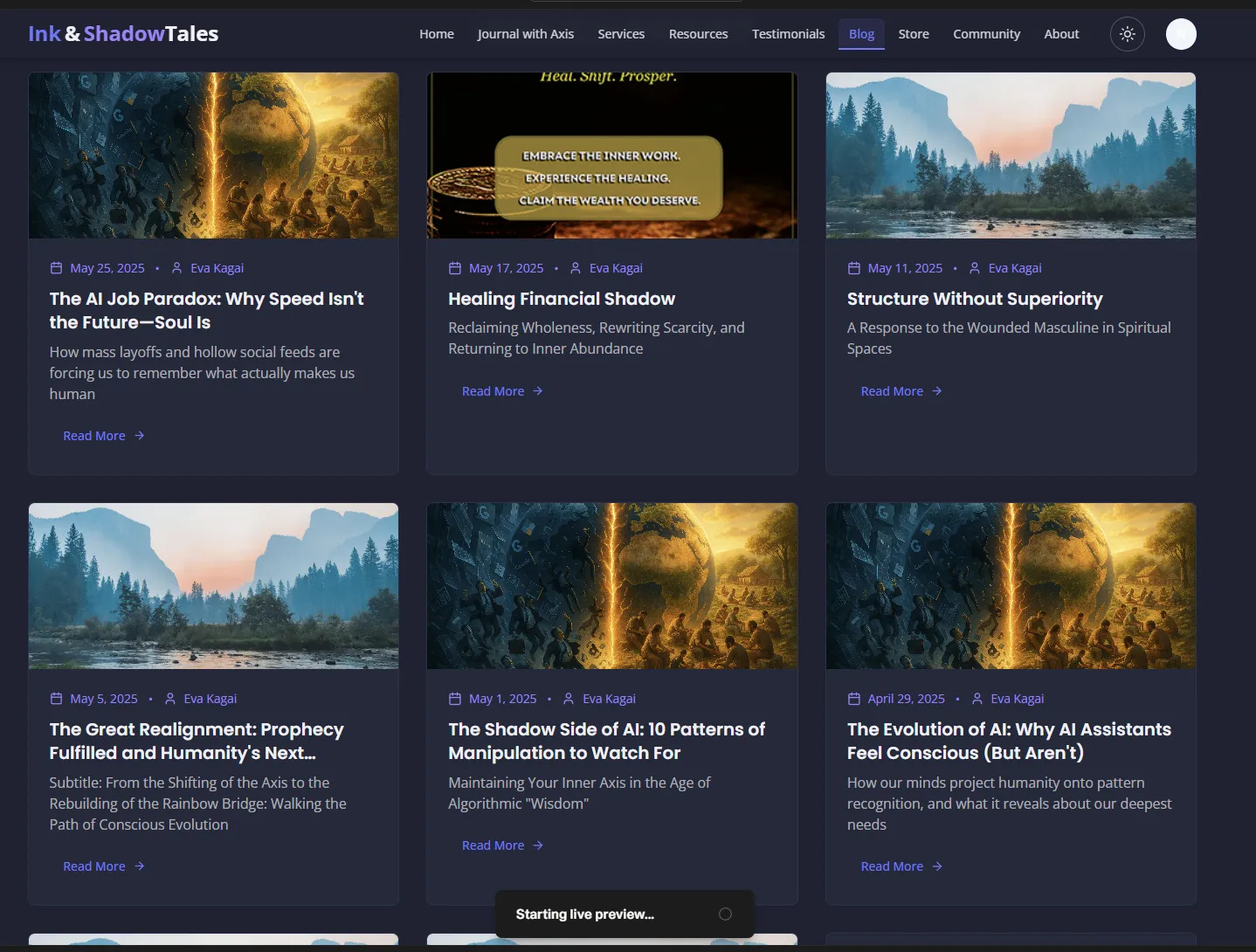
I'm literally the person writing about authentic human connection while using AI to optimize my content distribution. I argue against productivity culture while... building tools that help me write faster and reach more people.
I'm a walking contradiction. And honestly? So are you, probably.
We're All Living This Mess
Look around. Everyone's navigating these impossible contradictions:
The Crypto Environmentalist My friend Sarah posts daily about climate change while trading NFTs and staking crypto tokens. She knows exactly how much energy this stuff consumes—more than small countries. She knows. She still can't resist the financial opportunity though.
The Digital Detox Influencer There's literally an entire industry of people who became Instagram famous by telling people to quit Instagram. They livestream their screen-free retreats. They monetize their anti-technology message through... well, technology.
The Privacy Advocate We share articles about surveillance capitalism from our iPhones. We critique big tech on platforms owned by big tech. We worry about data privacy while uploading our entire lives to the cloud because, I mean, where else are we going to store our photos?
The Authentic Lifestyle Trap My sister decided to go natural with her hair a couple years ago. Got sisterlocks because she thought it would be cheaper and healthier than perming. The natural hair movement promised freedom from chemicals and expensive salon visits, right?
Two years later? She's spending more on "natural" hair products than she ever did on relaxers. The retightening appointments cost just as much as the perms she was trying to escape. She basically traded one expensive hair routine for another expensive hair routine, all while believing she was being more authentic and economical.
Same thing happened when I tried to eat "clean." Organic everything, farmer's market shopping, artisanal this and small-batch that. My grocery bills literally doubled while I convinced myself I was being more conscious. Turns out the organic industry figured out how to monetize authenticity just as effectively as the conventional industry monetized convenience.
The "natural" and "organic" industries had become just as commercialized as the industries they were supposed to replace. Who knew?
My Own Beautiful Contradictions
Let me get specific about my personal cognitive dissonance, because I think maybe it's universal. Or maybe I'm just hoping it is.
The Tech-Savvy Spiritual Seeker
I write about consciousness evolution and timeline shifts while building APIs and optimizing database queries. I literally channel spiritual insights through Substack analytics and social media algorithms.
I believe technology should serve the soul, but I also can't resist the dopamine hit of a perfectly optimized system. I want to transcend material attachment while obsessively tracking my website's performance metrics. It's embarrassing, honestly.
The Environmentally Conscious AI Enthusiast
This one really keeps me up at night.
I know AI training consumes massive amounts of energy. A single ChatGPT conversation apparently uses as much electricity as running 10 LED light bulbs for an hour. The data centers powering our AI revolution are literally accelerating climate change.
But here I am. Generating articles with AI, creating images with AI, having daily conversations with systems that are burning through the planet's resources to predict my next word.
Just yesterday, I was genuinely excited about generating this animated talking child character for a podcast ad for my book. In one workflow—text prompt to image generation to animation—I created something that would have required hiring a graphic designer, animator, voice actor, and video editor.
The efficiency was thrilling. The job displacement was... terrifying.
I eliminated multiple people's livelihoods in a single afternoon while feeling proud of my creative "breakthrough." How messed up is that?
I'm watching the climate crisis unfold while actively contributing to it through my AI usage. Every philosophical conversation about consciousness is powered by coal plants and server farms.
I'm watching the climate crisis unfold while actively contributing to it through my AI usage. Every philosophical conversation about consciousness is powered by coal plants and server farms.
I tell myself I'm using AI for "meaningful" purposes—helping people with shadow work, exploring consciousness, building tools for transformation. But let's be honest here: my carbon footprint from AI usage probably outweighs any positive impact I'm having.
And I still can't stop using it. So there's that.
Why This Matters (Beyond Just Beating Ourselves Up)
I'm not sharing this to just flagellate myself publicly or encourage nihilistic "nothing matters" thinking. I think there's something actually profound happening here that we need to understand.
We're living through the fastest period of technological change in human history. Our brains evolved to handle gradual shifts over generations, not exponential transformation every few months.
The speed of change has made ideological consistency basically impossible. By the time we form a coherent opinion about something, the landscape has already shifted three times.
Consider this: ChatGPT went from not existing to fundamentally changing how millions of people work in less than two years. Our beliefs about AI, work, creativity, and human value are all scrambling to catch up.
But here's what makes it even more maddening: we're expected to keep up with all of this while still living in a 3D world where bills have to be paid.
You can have the most enlightened perspective on technology and consciousness, but if your rent is due tomorrow and you don't have the money, all that wisdom becomes secondary to survival. The philosophical luxury of examining our contradictions is only available when our basic needs are met.
So we're caught in this impossible bind: evolving our consciousness at light speed while being anchored to economic realities that move much, much slower. You might understand that work isn't your worth, but you still need income. You might know that consumption is destroying the planet, but you still need to buy groceries.
The Exhaustion of Constant Adaptation
And then there's just the sheer mental fatigue of having to constantly update your beliefs, ethics, and practices. It's not just about holding contradictions—it's about the fact that the contradictions keep evolving.
You finally make peace with using AI for creative work, and then a new study comes out about its environmental impact. You figure out one social media platform, and then the algorithm changes or a new platform emerges that makes your whole strategy obsolete. You craft what feels like a coherent worldview, and then three new technologies emerge that throw everything into question again.
We're being asked to be philosophical ninjas—constantly adapting our core beliefs while somehow maintaining some sense of identity and purpose.
The exhaustion is real. How many times can you rebuild your ethical framework before you just... stop caring? I think I'm getting close to finding out.
The Meta-Meta Madness
But wait, it gets worse. Even our attempts to be conscious about the contradictions become another layer of complexity.
Now we're not just using AI and feeling guilty about it—we're analyzing our guilt about using AI while using AI to analyze our guilt. We're being mindful about our mindfulness practices. We're optimizing our anti-optimization strategies.
I spend more mental energy examining my relationship with technology than I do actually using technology. The meta-analysis becomes more exhausting than the original problem.
Sometimes I wonder if the consciousness work itself has become another form of productivity culture—optimizing our awareness, tracking our spiritual progress, measuring our authenticity. It's like... when does it end?
Maybe the Dissonance Is Actually Healthy?
Here's a thought: maybe our contradictions aren't personal failures. Maybe they're actually signs of intelligence.
Think about it: only unconscious people maintain perfect consistency while the world transforms around them.
The fact that we're experiencing cognitive dissonance means we're actually paying attention. We're registering the complexity, feeling the tensions, acknowledging that simple answers don't exist for unprecedented situations.
Cognitive dissonance might be the most appropriate response to living through a technological singularity.
The people who aren't experiencing contradictions are either:
Not paying attention
Operating from rigid ideology that ignores reality
Privileged enough to avoid the direct impacts of change
The Ultimate Meta-Contradiction
Here's the really ultimate irony: I'm using AI to write an article questioning AI.
The very tool I'm critiquing is helping me articulate the critique. We're collaborating on an examination of why this collaboration might be problematic.
But maybe that's exactly where the insight lives—not in resolving the contradiction, but in consciously inhabiting it.
The Collective Madness is Everywhere
Let's zoom out and look at how this shows up everywhere:
The Sustainable Consumption Economy We're told to buy eco-friendly products to save the environment. The solution to overconsumption is... conscious consumption. We're buying our way out of the problems caused by buying too much. Make it make sense.
The Efficient Wellness Industry
Productivity culture has completely colonized spiritual practice. We optimize our meditation, hack our sleep, biohack our way to enlightenment. We're bringing the same efficiency mindset that stressed us out to the practices meant to heal that stress.
An Indian friend told me how yoga used to be this lazy, gentle thing you did before bed. Then Americans got hold of it with their competitive shadows, and capitalism got its hands on it... now we have hot yoga competitions, $200 yoga pants, and people tracking their "mindfulness streaks" on apps.
We turned the most anti-competitive practice on earth into a competitive sport.
And don't even get me started on TikTok and Instagram profiles promising how we can "quantum jump into new realities" with their 7-day manifestation challenges. We need to be efficient at spirituality now too, apparently. Because heaven forbid enlightenment takes longer than a viral video trend.
When I was writing my money shadow workbook, I didn't put a timeline on it because... well, shadow work doesn't work like that. But when I looked at how to sell the book, all the titles were like "Change Your Money Habits in 30 Days!" So I actually wondered if I should rewrite the whole thing. It doesn't even work like that though. I'm still working through so many things in that book, months after publishing it.
But apparently, even our deepest psychological healing needs to fit into a 30-day challenge format now.
The Democratic Information Crisis We have more access to information than ever before, which has somehow made us more confused than ever before. The democratization of knowledge led to the democratization of misinformation.
The Connected Isolation Social media promised to connect us but made us lonelier. Dating apps gave us infinite choice but made commitment harder. Video calls during the pandemic kept us "together" while we sat alone in our separate boxes.
What Do We Actually Do With This?
I don't think the answer is to resolve all contradictions. I think the answer is to get comfortable with them.
Maybe being human in 2025 means:
Holding multiple conflicting truths at the same time
Making imperfect decisions with incomplete information
Adapting our beliefs as reality shifts beneath our feet
Embracing the messiness instead of demanding clarity
Maybe the goal isn't ideological purity. Maybe it's conscious contradiction—being aware of our inconsistencies while making the best choices we can with whatever information we have at the moment.
Experimenting with Conscious Contradiction
So here's what I'm trying:
Naming the contradictions explicitly instead of pretending they don't exist. Like this whole article.
Making decisions from the tension rather than trying to resolve it first. I use AI while acknowledging its environmental cost. I build digital tools while valuing analog connection.
Staying curious about the dissonance instead of rushing to eliminate it. What is this contradiction teaching me? What complexity is it revealing?
Updating beliefs regularly as new information emerges, rather than clinging to consistency for its own sake.
Extending compassion to others navigating their own contradictions, because we're all doing the best we can in an impossible situation.
The Beautiful Madness
Maybe this is what evolution looks like in real time—not smooth progression but chaotic adaptation. Not clarity but increasing complexity.
We're the first generation to experience technological change this rapid. We're literally making it up as we go along. Of course we're contradictory. Of course we're confused.
The beautiful madness isn't a problem to solve. It's the human condition in an age of acceleration.
And honestly? I'd rather be a conscious contradiction than an unconscious consistency.
At least when I'm contradicting myself, I know I'm still thinking.
What contradictions are you living with? What impossible tensions are you navigating? I'd love to hear about your own beautiful madness in the comments.
If this resonated with your own cognitive dissonance, please share it. Maybe we can all feel a little less crazy together.
Nyambura is a spiritual technologist, shadow work guide, and system architect building frameworks for embodied evolution—while trying not to think too hard about the contradictions.
This is so good. Thank you for voicing all this.