The AI Job Paradox: Why Speed Isn't the Future—Soul Is
How mass layoffs and hollow social feeds are forcing us to remember what actually makes us human

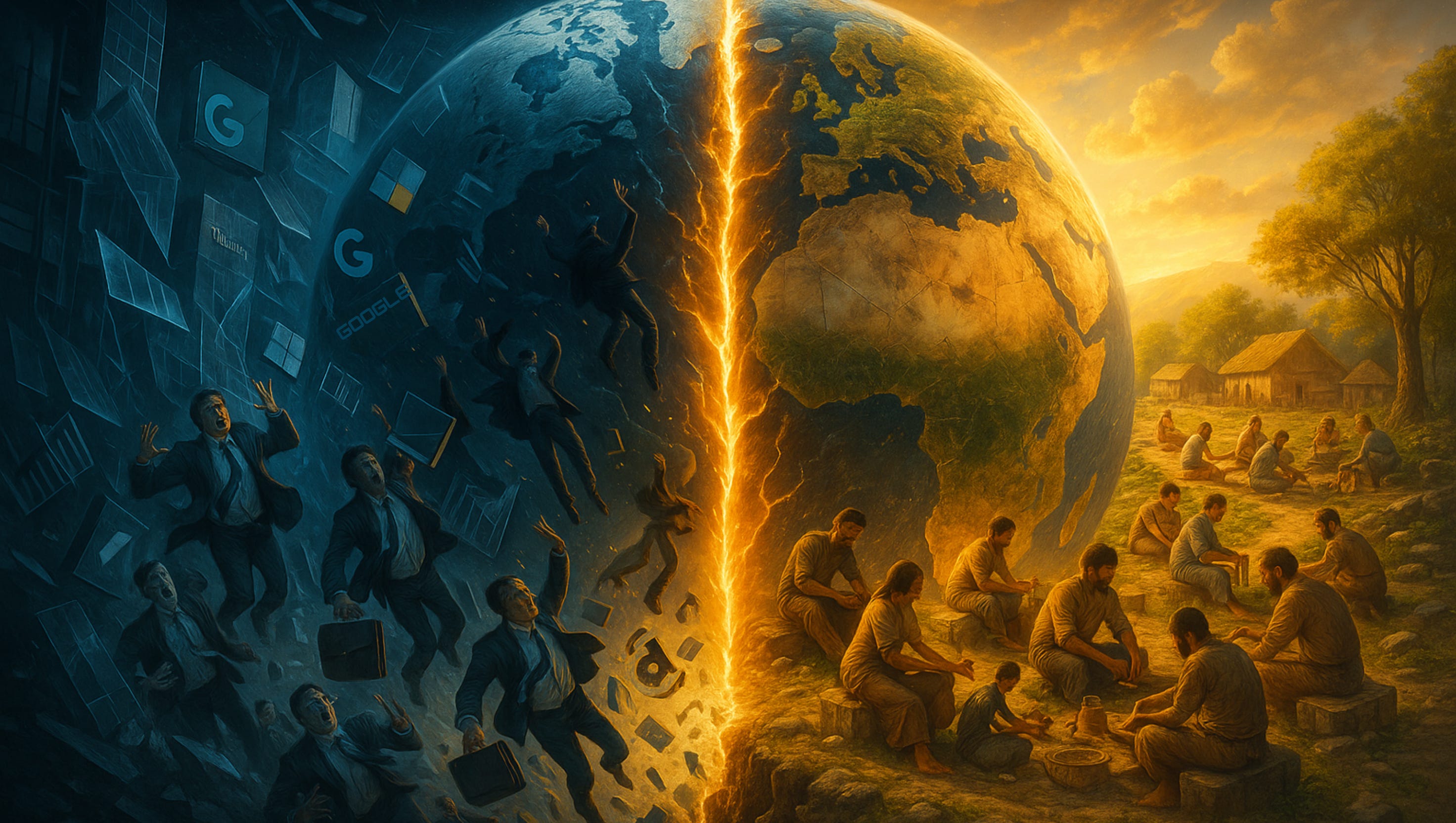
We're not approaching economic disruption.
We're living inside it.
AI is scaling faster than our systems, ethics, or emotional frameworks can keep up with. Jobs? Disappearing. Productivity? Skyrocketing. Meaning? That's the new scarcity.
Here's the paradox I keep seeing everywhere:
If AI replaces human labor to boost profits... who will have the income—or the motivation—to buy what it produces?
We're building an economic machine that no longer needs people but still depends on their consumption.
This Isn't Just About Employment
This is about identity. It's a spiritual issue. A mirror.
What is value when speed, skill, and precision are no longer human advantages?
What does it mean to be human in a world of machine-generated perfection?
I've been watching this unfold in real time. The layoffs aren't just numbers—they're people losing their sense of worth along with their paychecks. Because we've been programmed to believe our value equals our productivity.
We ask "What do you do?" not "Who are you?" We measure success by output, not by the quality of presence we bring to the world.
Even Our Digital Spaces Are Changing
Social media is starting to feel hollow. But honestly? It always was—if you weren't trapped by the consumerism and show-off culture of Instagram and TikTok, you could still find real communities, authentic voices cutting through the noise.
Now it's different. The comments feel AI-written to be perfect. The responses sound like chatbots. You start replying to what you think is a human and realize you might be talking to an AI agent programmed to reply in this capitalistic, efficient AI world we're heading toward—where you can make a thousand posts in a day to get as many views and squeeze as much money as possible out of social media.
People can sense the difference between a post and a presence. Between content that's generated and truth that's lived. And it's pushing us away from digital connection toward something more real.
They're hungry for the real.
I see it in my work all the time—people craving authentic connection, genuine conversation, something that can't be faked by an algorithm. The more AI-generated content floods our feeds, the more we value what comes from actual human experience.
The Government Response? Missing the Point
I did some research on what governments are actually doing about AI displacement. Republicans are saying companies should handle retraining themselves. Democrats are proposing extensions of existing programs. Some cities are running UBI pilots with a few hundred people.
The tech industry's answer? "Learn to use AI to leverage it." They say: boost your productivity, increase your efficiency, make yourself indispensable by becoming an AI power user.
But here's the fatal flaw in that logic: how long can that last? If I can write this article using AI tools I developed myself, then I don't need the person who originally built those tools. And if AI can maintain its own code, write its own updates, even build better robots... then eventually, even the AI developers become redundant.
We're essentially telling people to climb aboard a ladder that's dissolving beneath them. Each rung you reach, another one disappears. The "learn to work with AI" advice is just buying time before the next wave of displacement.
But here's what they're all missing: this isn't a retraining problem. You can't just teach someone new skills when their entire sense of self was built around being "productive." That's trauma work, not job training.
Most people have never asked themselves "Who am I beyond what I do?" And when AI forces that question, it's going to break a lot of people before it frees them.
And let's be honest—not everyone has the luxury of soul-searching when they're worried about paying rent. But even for those with some stability, this transition is messy and terrifying. There's no roadmap for moving from "I am what I produce" to "I am inherently valuable."
What Comes Next Could Be More Human
But here's where it gets interesting. What if this disruption is forcing us toward something better?
In the near future, I see:
Community mattering more than convenience.
Resonance outshining recommendation engines.
The human voice cutting through the optimized noise.
We don't need to resist AI. We need to remember who we are.
Let AI handle the repeatable. Let humans hold the relational.
It's time to rebuild our economy around new kinds of value:
The person who can hold space for a community processing collective grief
Someone who helps organizations navigate conflict with wisdom instead of just efficiency
The facilitator who guides people through major life transitions
Creators who build things that heal rather than extract
Systems that prioritize regeneration over endless growth
Think about it: AI can write code, but can it sit with you while you're having a breakdown? It can optimize supply chains, but can it help a neighborhood figure out how to care for their elderly? It can generate content, but can it hold the complexity of human healing?
The Real Work Is Inner Work
This is where shadow work comes in. Not just for individuals, but for our entire culture.
We need to process the collective grief of losing the "work equals worth" identity. We need to face the fear that maybe we never knew who we were beneath our job titles and achievements.
The transition looks different for everyone. Some people will do years of therapy. Others will find their way through community, through creativity, through serving something bigger than themselves. There's no single path, but there is a common thread: learning to value presence over productivity.
Most people would rather cling to a sinking ship than face that emptiness. But the ones who can sit with that void, who can do the inner work of rediscovering their inherent value... they're going to be the ones who build what comes next.
Yes, the Current Model May Collapse
But what comes after could be more human, honest, and whole.
And it's already starting. I see people choosing community over convenience, leaving corporate jobs to become coaches and healers, starting worker cooperatives, building intentional communities. The infrastructure for a different kind of economy is being built by people who got tired of optimizing their lives away.
We just have to be brave enough to join them.
The question isn't whether AI will displace jobs—it's already happening. The question is: will we use this crisis to remember what human beings are actually for? What we bring that no machine ever could?
Because at the end of the day, AI can optimize everything except the one thing that matters most: the capacity to love, to hold space, to be present with what is.
That's not a job. That's not productivity.
That's soul.
And soul is what the world is starving for right now.
So here's what I'm asking: Start with one simple question. Not "What do I do?" but "Who am I when I'm not doing anything?" Sit with that. Let it be uncomfortable. Let it be empty at first.
Because in that emptiness, you might discover what no AI can replicate: the irreplaceable essence of who you actually are.
What's your take on this? Are you feeling the shift away from productivity-based value? I'd love to hear your thoughts in the comments below.
If this resonated with you, please share it. The conversation about what comes after the job economy needs to happen everywhere.
Nyambura is a spiritual technologist, shadow work guide, and system architect building frameworks for embodied evolution.
Well said. We are going to grow hungry for the authentic and real.