
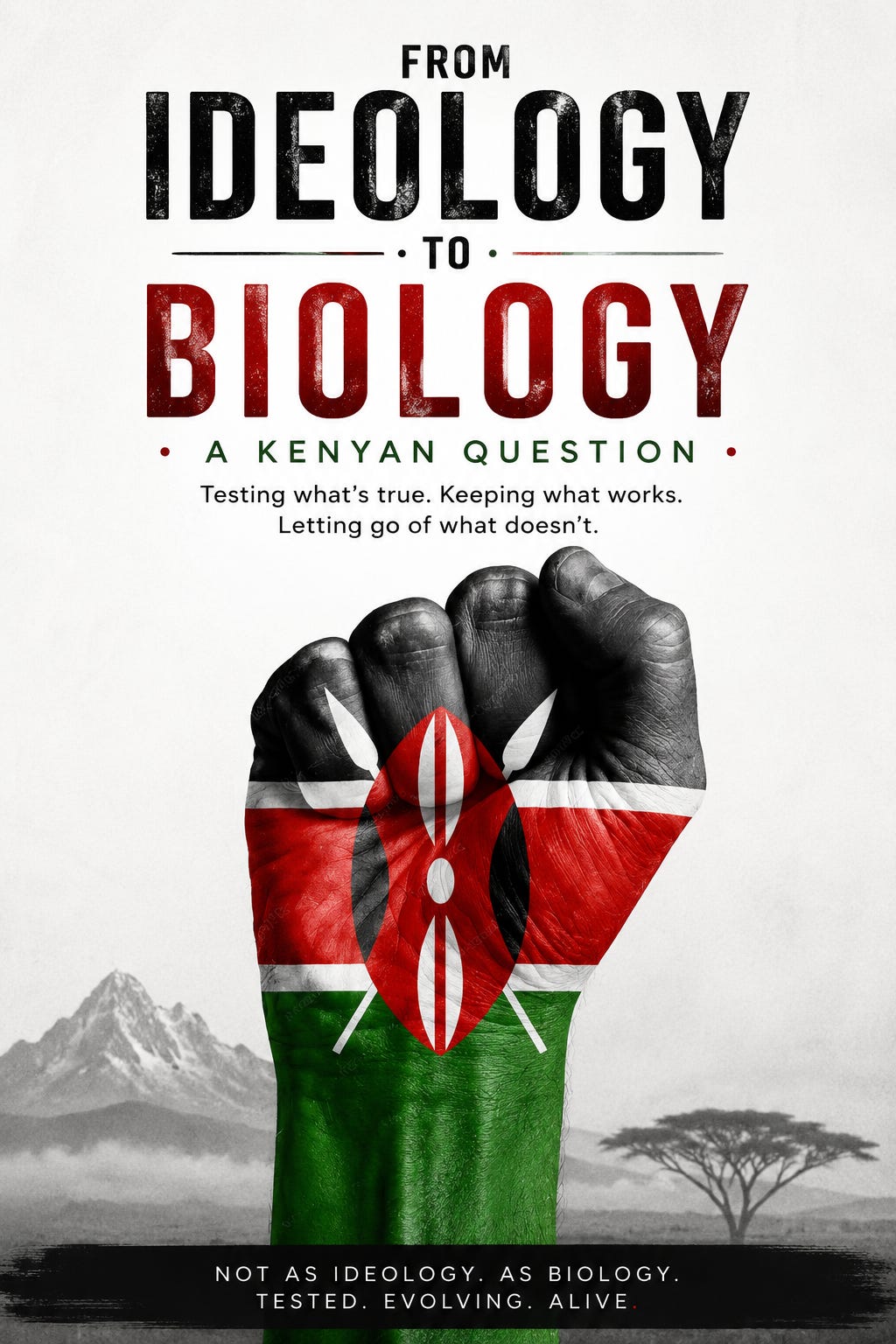
I asked myself a strange question this week.
If a curse travels through blood, how can a blood ritual remove it? Same channel, two directions.
The thought sat with me longer than I expected.
I think of people I have known who went to see a traditionalist when something in the family would not resolve. I was young when I first witnessed this, and I judged it, the way you do when you have absorbed enough of the other system to believe the old one is shameful by comparison.
I understand it differently now.
As I grew older, I went to see a traditionalist myself, to understand my own lineage and the issues that have ailed it. The shame I had carried since childhood, the same shame I once aimed at other people for doing exactly what I was now doing, slowly started to dissipate.
A bee is real. But the word bee also carries a whole inherited map most of us never built ourselves. Honey, sting, hive, bear, flowers, yellow and black, all of it handed to us complete, long before we ever met an actual bee.
The word ancestor works the same way. The ancestors are real. But the word ancestor also arrives carrying a map we did not build. Obligation. Lineage. Blood memory. Debt. A whole architecture of fear and duty, inherited rather than tested.
Some of what I carry under that word is real. I felt it in the bath this year, in the prayer I said for my family line, in the release that came after.
That was not inherited. That was mine, tested against my own life and found true.
But some of what I carry under an ancestor is just an old map, still running, never actually checked against anything.
Any immigrant who has traveled back to the motherland does not need to be told there is a certain energy there, a feeling of home that arrives before any thought. I felt this myself on a recent trip and meditation on Mt Kenya. Something moved in me on that mountain that was not belief and was not an idea I had studied. It was physical. The mountain did not ask what religion I followed or what doctrine I held. Whatever happened there happened before thought could shape it into a story.
This is what makes me wonder whether some of what we call spirituality was originally biology. Not ideas about the sacred, but a direct relationship with land, season, body, and place, recognized by the nervous system long before the intellect arrives to explain it.
The traditional system in Kenya was, once, a way of staying connected to exactly that. Land. Season. The people who came before. It gave power and agency through ritual.
But it also calcified into something heavier. The ngomi system, the fear that ancestors require constant appeasement, the sense that you owe a debt that can never quite be paid in full.
Families held at ransom by their own dead.
Matías De Stefano describes inheritance this way:
Sap moving through a tree. Roots absorbing what came before and carrying it up through the trunk into branches alive today.
Biology has its own version of the same image. A grandmother who survived famine can pass her body’s fear of scarcity down as a nervous system pattern, not just a story repeated at dinner, but an actual physiological setting, inherited the way eye color is inherited.
What ideology calls a curse, biology sometimes simply calls an old survival strategy, still running in cells that never lived through the original hunger.
I understand why this was exhausting. I understand why, when something offered relief, people took it.
Christianity arrived offering exactly that relief. One sacrifice. Done. The blood of Jesus paid once, covering everything going forward. No more cattle. No more appeasing an ancestor who could never be fully satisfied.
For people exhausted by an endless system of debt, being born again must have felt like finally being allowed to put something down.
But the relief came at a cost nobody names clearly enough.
The connection to land went with it. The old system kept people in relationship with the soil, the seasons, and the actual ground they stood on. The new one moved the relationship with the divine away from the soil and the seasons, toward something more distant and abstract.
And the power moved too. It used to live in the family, in the clan, in the ritual you could perform yourself. Now it lived in an institution you had to travel to, kneel inside, and trust to administer what was yours to begin with.
I still love his teaching. Most people know him as Jesus, the name the Bible gave him. The more I have learned, the more I have come to understand him as Yeshua, which feels closer to who he actually was before translation and empire reshaped the name and the story around it. I have never felt the need to call anyone Lord. But I have called him Jesus, and I feel that love and protection that people talk about. I have felt it directly, at a Catholic retreat that went deeper than anything I expected.
But I have also read enough now to know that the Bible I was handed is not the whole of what Israel itself practices and believes. There are traditions that never made it into what was exported to us. I cannot unknow that. And once you know it, going back to the version that asks you not to ask further questions becomes very hard.
So I hold both. The love is real. The borrowed nature of the package is also real.
What I am working out in my own life, between the traditionalist and the church, between Yeshua and the ancestors, the country is working out at scale.
Here is where I think we actually are, as a country.
Both systems have weakened. The old one, eroded by generations of religious pressure and now also rightly questioned for what it protected that should never have been protected. The new one, having promised a transformation that has not delivered the safety or worth it claimed it would.
The crime. The greed. The scarcity.
People disconnected from both their roots and their future will often try to fill the gap with consumption, status, certainty, or power.
The sense of not belonging anywhere, not being enough anywhere. I do not think these are separate problems from the ideology question. I think they are what happens when two systems collapse against each other, and nothing has yet grown in the space between them.
This is not necessarily a collapse. It might be exactly what biology looks like when an old structure has outgrown its usefulness and a new one has not yet finished forming.
I think I understand now why this state feels so uncomfortable.
If people were actually free to test, keep, and discard what no longer serves them, without losing their place in either community, it would feel like enormous relief. Pleasure, even, in the most literal sense. Energy is finally allowed to move instead of bracing against obligation.
And that is precisely why both systems use the same tool to prevent it.
Shame.
But I think the deeper fear underneath the shame is belonging.
If I stop following the old obligations, will I still be part of my family? If I question the religion I inherited, will I still belong to my community? If I say what I actually believe, will I still belong anywhere at all?
Shame rarely threatens punishment directly. It threatens exile. And exile, for people whose whole survival once depended on the clan, the church, the family line, is the oldest fear there is.
I do not think the answer is choosing a side. Not a return to the old system exactly as it was, with everything it asked people to fear and pay for. Not a tighter grip on a religion that was never built on this ground.
I think what wants to be born is something that has not been built yet. People are testing what actually produces belonging and safety now, in this generation’s real conditions, keeping only what survives that test. Some of it from Jesus’s teaching. Some of it from the ancestors. Some of it from what science and lived experience have shown to actually work.
Not as ideology. As biology. Tested, evolving, allowed to change again when the conditions change again.
This is, in a much smaller way, what I have been doing in my own life all year. Taking what serves. Releasing what does not. Refusing to let any one system own the whole of me.
Maybe the country needs the same permission I have been slowly giving myself.
To test. To keep what works. To let go of what does not.
Without shame attached to any part of it.
🤍
When Eva is not asking whether a curse can be undone by the same blood that carries it, she is still testing what survives contact with her own life. Keep what works. Let the rest go quietly.
She writes about the worth wound, shadow work, and what it looks like to choose biology over ideology, one honest essay at a time.
If this essay moved you, share it with someone who needs it.
Or share the publication.
Or simply stay.