
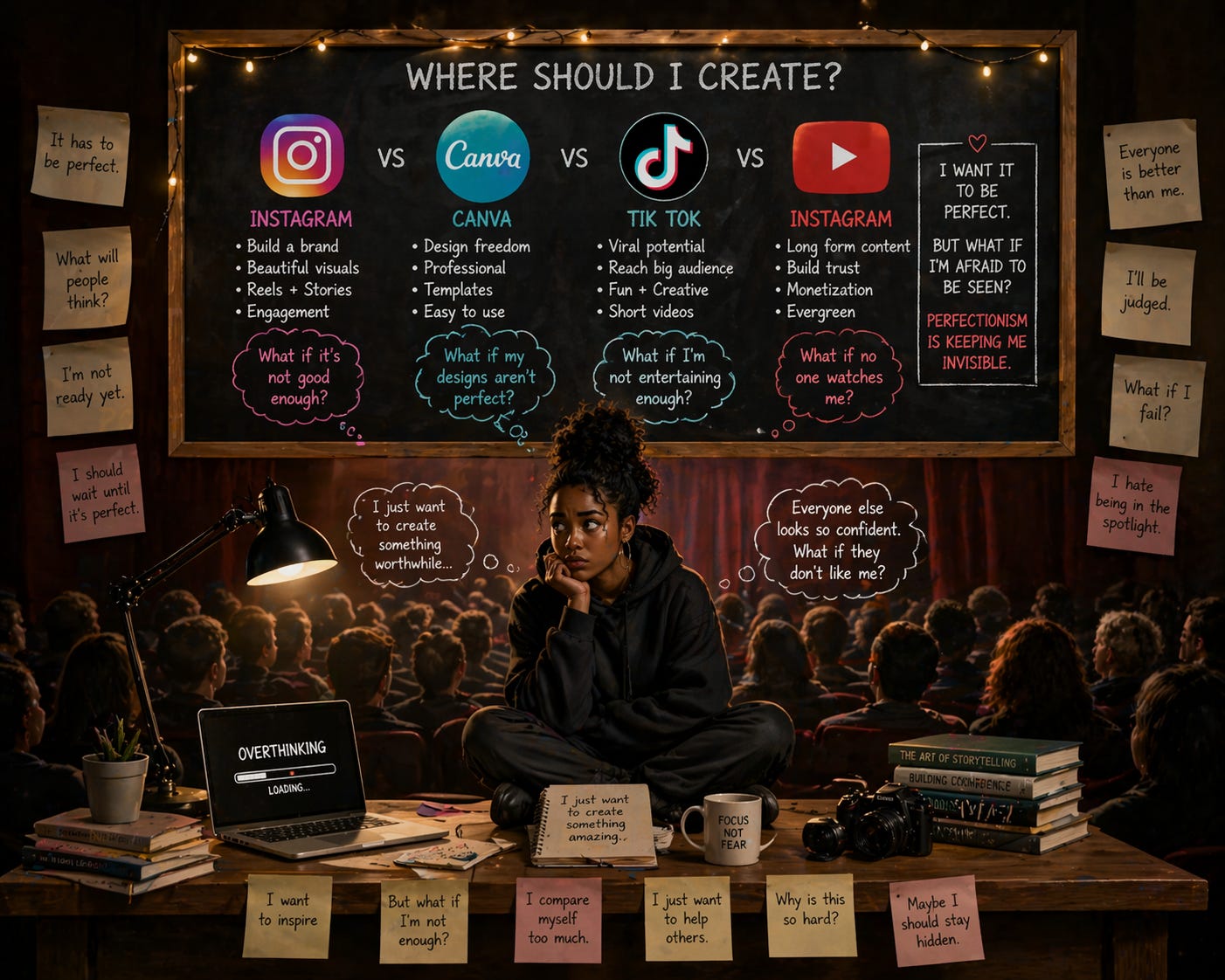
I have always loved expressing myself.
For twelve years, I trained election officials in Kenya on new technology. Biometric voter identification. Results transmission systems. Things people had never used before. And mostly they were boomers, because they’re the ones managing the polling stations. You try teaching technology to the analog generation, the one that doesn’t like technology, doesn’t even trust technology, in a pressure-filled environment like elections. And you want them not only to absorb it, but also to relay it to others with the same mentality, and then to actually use it to authenticate voters. Let me know how that goes.
But I loved it.
And I was good at it.
Not because I memorized the manual.
Because I made it mine. I added my own stories. I made jokes. I knew where to slow down and where people would get stuck. I remembered being on stage in high school, the rhythm of standing in front of a room and making something land. So when I was training, I was in theatre. I acted out what could go wrong with humor, not to shame people, but to give them both sides.
And I can tell you, during election day — which is a one-day exam in Kenya — the few calls I got from the roughly 10,000 officials scattered across my region weren’t about the different scenarios. They were about things I could resolve, like gadget failures.
When I am able to pass information from me to others that is train, I exhale.
That’s how I know it’s where I belong.
But something happens when the subject is me.
When I’m not relaying someone else’s curriculum. When I’m the material.
Something tightens.
I see it most clearly on social media.
I have something I want to share. A thought. An image from a walk. A piece of writing I’ve been sitting with.
And before I can post it, the voices start.
Which platform, though? Is Instagram still the move, or has TikTok taken over? Do you think this should actually be a video? You know it needs an image. The writing needs to sit on the image like this. How does it look? Better to go with a cleaner font and a voiceover? Would it be better if I ran it through Canva first? Have you thought about a carousel? You should post weekly. No, daily. No, just be consistent.
I can hear how loud it is. I’m sitting there laughing at myself, because the original thing I wanted to share has already disappeared under five layers of logistics.
By the time I finish negotiating with all those voices, a week has passed. And now it’s midnight, and I’m learning how to create better carousels using Canva AI.
Sometimes a month.
And the thing I wanted to share is still sitting in my drafts, having been overtaken by new events, which will go through the same process of negotiations.
For a long time, I thought this was a problem of perfectionism.
It’s not.
Perfectionism is just where it hides.
Underneath the perfectionism is an older voice that says:
You are not enough. And now you want to be seen and expose this, so to be safe, you will have to control how others see you.
And perfectionism is the strategy to cover that.
If I can make it look perfect — the image, the caption, the format, the timing — then maybe other things will happen with my message.
Maybe they will see me in a different light. Maybe my message will stand out, be unique, and therefore be chosen. Maybe they won’t misunderstand it, because I have been very clear and given them all the information, so they can’t judge me. They will see this, and I will finally get the validation.
Lately, that wound has been finding new places to hide.
Now it sounds like:
But there’s so much AI now. Everyone can do this. You need to stand out. If you’re not unique, what’s the point?
Same wound. New costume.
And even right now — writing this — the wound has found an even newer costume.
The em dashes.
Everyone’s going to read this and think you used AI to write it. They’ll think you don’t have your own voice. They’ll think you’re not clever enough.
I’m laughing as I type this, because — of course. Of course, the voice found one more place to live. It is never enough.
Same wound. Newer costume.
Yesterday I had a small test.
I had written a Substack essay. I had it edited the way I wanted on my computer. Clean. Formatted. Ready.
Someone wanted to read it. I wanted to send it through Substack, not just as a Google Doc.
But my Substack was logged out on my computer. I couldn’t pull it up there. I could only post from my phone — where I couldn’t format it the way I’d planned.
So I had a choice.
Wait until I was home and could post the perfect version.
Or post it now, imperfect, without the formatting I had in mind.
I posted it.
Not because I’d done any big healing work in that moment. Just because the need was more pressing than the perfection.
Later that day, I was back at my computer. I posted the “real” version — the one I’d polished.
And here’s what happened.
The imperfect one has more comments. More reactions. More people are actually reading it.
The perfect one is sitting there, beautifully formatted, with barely a pulse.
I can’t edit the imperfect one anymore. Once people start commenting on Substack, you can’t change it.
So it’s just there.
Imperfect. Read. Responded to.
And the not-enough wound is looking at it, going — huh.
Here’s what I’m learning.
The antidote isn’t to stop posting, nor is it to stop caring about standards.
The antidote is more specific than that.
If perfectionism has a real standard in it — something that actually serves the work — give it a container. Decide: I post weekly. It looks like this. Then perfectionism has somewhere to live that isn’t in my throat every time I have something to say.
And if what’s actually running is the being-seen wound — the part that wants the post to make people think I’m smart, powerful, put-together, doing well — that’s a different move. That one has to be handled before posting. Not after the reactions come in.
Because if I need the post to make people see me a certain way, I’m not expressing.
I’m auditioning.
So the question I’m learning to ask myself, right before I post, is this:
Am I trying to make something happen? Or am I letting something move through me into the world?
Those are two very different orientations.
One is performance. The other is release.
One needs the outcome to look a certain way. The other just needs to come out.
One is me trying to arrive somewhere with the post. The other is the post being the arriving.
And then — before it goes up — I practice saying:
I am enough before this goes live. I don’t need this to land a certain way to be okay. I’m just passing through my message.
And I post.
Even when it’s not the format I planned. Even when the image isn’t right. Even when the caption feels clumsy. Even — when — it — has — em dashes.
Not perfectly.
Honestly.
Before you close this tab — sit with me for a second.
When you feel something real… what happens in the moment before you share it?
Is there a part of you that needs what you share to be “good enough” before it can be seen?
Where do you hold that pressure in your body?
What are you currently holding in… that wants to be expressed?
Can you tell the difference between expressing… and controlling how you’re seen?
You don’t need to answer them out loud. Just notice.
When I train, I exhale.
There’s nothing to prove. Nothing to become. Just something moving through me that needs to land.
I’m learning that expression is the same.
Not something to perfect. Something to release.
I’m learning to exhale here, too.
If this moved something in you, consider sharing it with someone who battles perfectionism and the fear of being seen.
You might be handing them the exhale they didn't know they needed.